Why Palmerston North residents should work with a financial adviser from Policywise insurance brokers
Manawatū-Whanganui is a key region in the lower North Island. It’s home to around 260,700 people, with Palmerston North City as its main urban centre. Palmerston North alone has a population of around 90,500 residents, making it a hub for education, logistics, and public services.
You will find a mix of students, families, professionals, and rural communities across Palmerston North, Whanganui, Feilding, Levin, and surrounding districts. Each group faces different financial pressures. But one thing remains the same: your financial security depends on your ability to earn an income and stay healthy.
How does the economy look in Palmerston North and the wider region?
Palmerston North has a stable and modestly growing economy. It plays a key role in transport, defence, education, and distribution across the lower North Island.
Recent data shows:
- The city contributes around 1.6% of New Zealand’s GDP
- Employment levels remain strong, supported by major employers in numerous industries, including:
- Public administration and safety
- Healthcare and social assistance
- Construction
- Wholesale trade
- Education and training

Source: Infometrics
Palmerston North is also known as a logistics hub, thanks to its central location and strong transport links. This supports industries like warehousing, freight, and manufacturing.
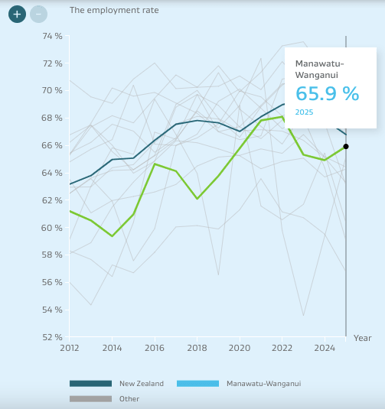
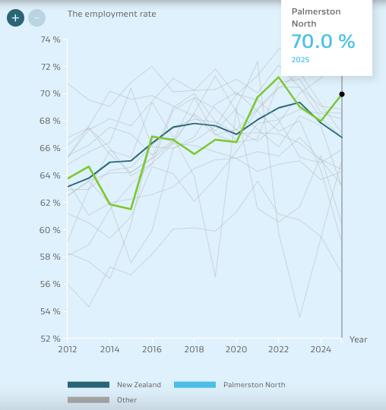
Such diverse industry in the region means that 65.9% of the Manawatū-Wanganui population is employed, and 70% of Palmerston North residents are working, either at home or on job sites.
Source: Regional Economic Activity Web Tool
Working adults in the Manawatū-Whanganui region receive a median income of $36,500. Palmerston North residents have a median income of $40,800.
For most households, a large portion of income goes towards rent or mortgage, council rates, utilities, and daily expenses. Your ability to receive an income is reliant on:
- Physical work (public admin, safety, construction)
- Ongoing demand (healthcare, education, retail)
- Being able to work consistently.
If illness or injury stops you from working, your income will be quickly affected.
How much are residents paying for housing?
There are 107,883 private dwellings in the Manawatū-Whanganui region; 68.8% are owned or held in a trust.
In Palmerston North, there are currently 33,987 homes, 64.1% of which are owned or under trusts.
These numbers keep growing alongside rental and housing costs, due to factors like:
- Population growth
- Limited housing supply in some areas
- Rising construction and borrowing costs.
Here’s how rent levels currently stand in Palmerston North:
|
The mean weekly rent in 2023 was $456.
|
As of the first quarter of 2026, the mean weekly rent rose to $474.
|
|

|

|
Source: Regional Economic Activity Web Tool
If your income suddenly stops because of injuries or illness, your ability to …
- pay your mortgage or rent
- cover essential bills
- support your family
… comes under pressure.
Your income is one of your most valuable assets and needs protection.
How income and mortgage protection insurance help
If you cannot work due to illness or injury, income protection and mortgage protection insurance can help keep your finances on track.
These plans provide regular payments while you recover.
Key benefits:
- Replace a portion of your income
- Help cover rent, mortgage, and bills
- Reduce financial stress
→ You can combine income and mortgage protection for more flexibility
→ Some policies include redundancy cover.
A Policywise adviser can compare options across insurers and help you choose what suits your situation.
Healthcare pressures in Palmerston North and the region
The public health system in Manawatū-Whanganui is under pressure, as it is New Zealand-wide.
Demand for healthcare continues to rise across the region, creating longer wait times for specialist care, delays in diagnosis and treatment, and limited access to some procedures.
Age
The median age in Palmerston North is 35.7 years, slightly younger than the national average. As of the most recent figures, 16.1% of the population is 65 or older. This is a growing number compared to 15.7% of residents aged 65 and over in 2023, and is still scaling up.
|
Age composition of the population, 2025
|
| |
Palmerston North City
|
New Zealand
|
|
Extended age
|
Level
|
% of total
|
Level
|
% of total
|
|
65-69 years
|
4420
|
4.9
|
272530
|
5.1
|
|
70-74 years
|
3510
|
3.9
|
225340
|
4.2
|
|
75-79 years
|
2930
|
3.2
|
185530
|
3.5
|
|
80-84 years
|
1970
|
2.2
|
117040
|
2.2
|
|
85-89 years
|
1160
|
1.3
|
65300
|
1.2
|
|
90 years and over
|
610
|
0.7
|
34400
|
0.6
|
Source: Infometrics
Additionally, Whanganui is among the top five health districts with the highest cancer incidence rate per 100,000 people at 364, according to a 2023 survey.
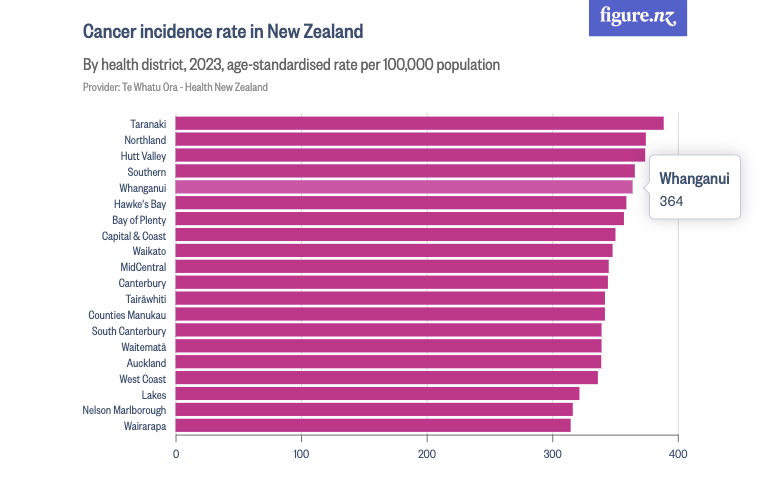 Source: Figure NZ
As of the April 2025 report for Whanganui alone:
- 1,049 patients were waiting longer than the recommended timeframe for a first specialist assessment
- 567 patients had been approved for treatment but were not treated within the required timeframe.
If you choose private care to avoid delays, your medical expenses, such as surgeries, specialist consultations and tests, cancer treatments, and medications, can cost tens of thousands of dollars.
|
Treatment or test
|
Indicative private cost
|
|
Prostate cancer surgery
|
$24,800 – $31,100
|
|
Breast cancer surgery
|
$8,700 – $27,200
|
|
Chemotherapy (course or advanced drugs)
|
$15,000 – $170,000
|
|
Radiation therapy
|
$20,000 – $70,000
|
|
Colonoscopy (diagnostic)
|
$2,000 – $3,800
|
|
Prostate biopsy
|
$5,500 – $8,000
|
How health and trauma insurance help
Health insurance enables access to private care faster and reduces out-of-pocket costs.
It can help you:
- Get treatment sooner
- Avoid public system delays
- Cover surgery, tests, and specialist care
→ Options include cover for cancer, mental health, and non-Pharmac drugs.
Trauma (critical illness) insurance provides a lump sum if you are diagnosed with a serious condition.
This helps you:
- Focus on recovery
- Cover treatment or time off work
- Support your family.
Total permanent disability (TPD) insurance gives extra protection if you are unable to return to work long-term.
It can help you:
- Cover ongoing living and medical expenses
- Make necessary lifestyle changes, such as modifying your home
- Support your family if you are no longer able to earn an income.
Lifestyle, dependants, and financial risk
The Manawatū-Whanganui region is home to 64,500 families; 21,981 of these are from Palmerston North.
In Palmerston North, 54.3% of the population is aged below 15 and over 65 years old. This number is slightly higher than New Zealand overall (54.2%).
41.5% of Palmerston North families are couples with dependant children, while 18.2% are solo-parents living with a child or children.
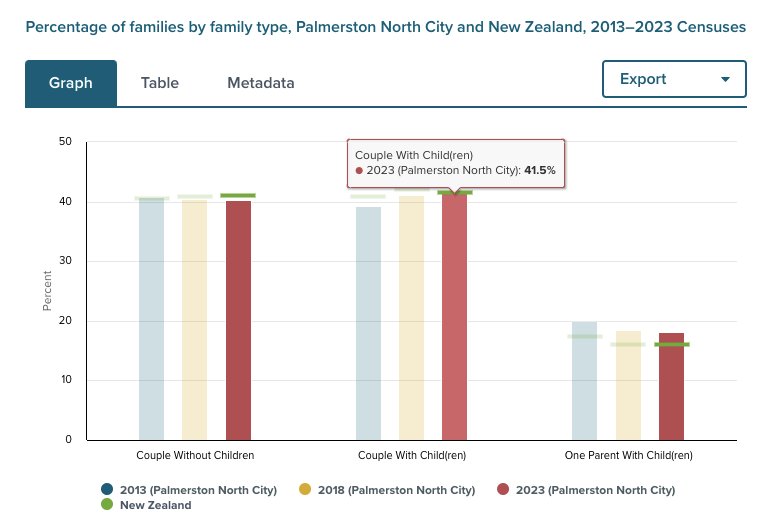 Source: Stats NZ
Among 90,500 residents, 7,492 people are beneficiaries of Jobseeker Support, Supported Living Payment, Sole Parent Support, and other main benefits. This includes 12.8% of the city’s working-age population.
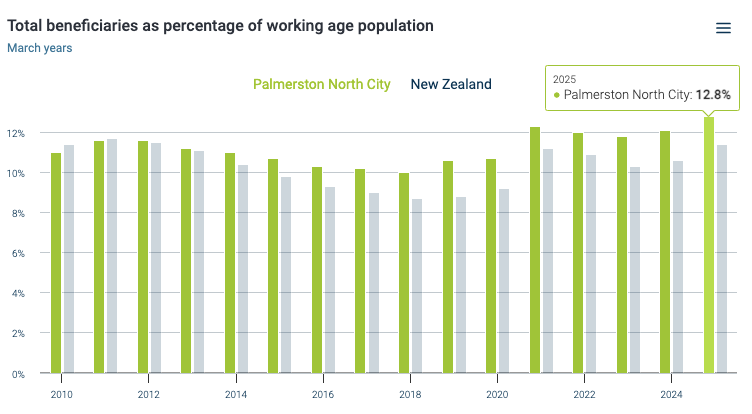 Source: Infometrics
With only a small portion of the population relying on benefit support, the majority of residents depend on their ability to work in order to earn an income.
If something happens to you and you cannot work, the financial impact can affect your partner, your children, your livelihood, and your long-term plans.
How life insurance helps protect your family
Life insurance provides a lump sum payment if you pass away or are diagnosed with a terminal illness.
This helps your family stay financially secure.
It can help:
- Pay off the mortgage
- Cover daily living costs
- Fund your children’s education
→ You can combine life cover with trauma or disability insurance
→ Options include joint and family life cover.
Why insurance and KiwiSaver work together
Insurance protects what you have today.
This includes your income, your health, and your family’s financial security if something unexpected happens.
KiwiSaver is a long-term savings scheme designed to help you build wealth over time.
It works by regularly contributing a portion of your income, along with:
- Employer contributions (if you are employed)
- Government contributions (if you meet eligibility criteria).
These contributions are invested to help grow your savings over time.
You can use KiwiSaver to:
When insurance and KiwiSaver work together, you create a more comprehensive financial plan.
- Insurance protects you if things go wrong today
- KiwiSaver helps you stay on track for the future.
This means you are not only prepared for unexpected events, but are also actively building towards your long-term goals.
Talk to a Policywise adviser today. Get the right insurance cover in place to protect your income, health, and family, while building a clear path towards your financial future with KiwiSaver.













.png?width=272&height=60&name=PartnersLife_Wordmark_RGB-2%20(1).png)
.png?width=226&height=42&name=logo_southern-cross%20(1).png)