Why Auckland residents should consider personal insurance
Aucklanders buy personal insurance for several main reasons:
- Public health-system delays can turn into time off work and out-of-pocket costs.
- The high cost of living and housing expenses mean even a short disruption in income can become a serious financial problem.
Having a financial safety net is more important than ever. Many people choose a layered approach to protection, combining:
- Health insurance for faster access to private care
- Life insurance to support loved ones financially if they pass away
- Trauma or disablement insurance for a lump sum in case of critical illness or permanent disability
- Income or mortgage protection to cover living expenses if they can’t work due to illness or injury
Alongside this, KiwiSaver plays an important role:
- Helps build long-term savings for retirement and first home goals
- Can provide some support in extreme situations, such as financial hardship or serious illness
💡 Why combine insurance + KiwiSaver?
- Insurance helps protect your income and reduces the need to dip into your retirement savings
- KiwiSaver supports your retirement and long-term goals and, in some cases, provides backup during hardships.
Auckland demographics
With a population of 1.8 million in 2025, Auckland accounts for 34% of the national population.
Estimated resident population of Auckland, by local board area, June 2025
|
Auckland local board area
|
Population
|
|
Rodney Local Board Area
|
83,400
|
|
Hibiscus and Bays Local Board Area
|
121,100
|
|
Upper Harbour Local Board Area
|
84,500
|
|
Kaipātiki Local Board Area
|
95,600
|
|
Devonport-Takapuna Local Board Area
|
61,100
|
|
Henderson-Massey Local Board Area
|
139,200
|
|
Waitākere Ranges Local Board Area
|
56,900
|
|
Aotea/Great Barrier Local Board Area
|
1,250
|
|
Waiheke Local Board Area
|
9,360
|
|
Waitematā Local Board Area
|
88,900
|
|
Whau Local Board Area
|
91,300
|
|
Albert-Eden Local Board Area
|
102,900
|
|
Puketāpapa Local Board Area
|
63,200
|
|
Ōrākei Local Board Area
|
86,800
|
|
Maungakiekie-Tamaki Local Board Area
|
88,100
|
|
Howick Local Board Area
|
173,200
|
|
Māngere-Ōtāhuhu Local Board Area
|
85,900
|
|
Ōtara-Papatoetoe Local Board Area
|
98,900
|
|
Manurewa Local Board Area
|
110,400
|
|
Papakura Local Board Area
|
84,200
|
|
Franklin Local Board Area
|
89,900
|
Source: Stats NZ
The region also has a relatively younger population, with a median age of 35.9 vs. 38.1 nationally.
Median age of population, Auckland Region and New Zealand, 2013–2023 censuses
|
Category
|
Auckland Region
|
New Zealand
|
|
2013
|
35.1
|
38
|
|
2018
|
34.7
|
37.4
|
|
2023
|
35.9
|
38.1
|
Source: Stats NZ
Although Auckland has a smaller share of residents aged 65 or older (13.3% vs 16.6% nationally in 2023), its ageing population is growing, rising from 11.5% in 2013. Some local board areas also have a much higher share (over 20%) of residents aged 65 and above.
Percentage of population by life-cycle age group, Auckland Region and New Zealand, 2013–2023 censuses
|
Category
|
2013 (Auckland Region)
|
2018 (Auckland Region)
|
2023 (Auckland Region)
|
2013 (New Zealand)
|
2018 (New Zealand)
|
2023 (New Zealand)
|
|
Under 15 years
|
20.9
|
20
|
19.2
|
20.4
|
19.6
|
18.7
|
|
15-29 years
|
22
|
22.7
|
20.9
|
19.9
|
20.5
|
19.4
|
|
30-64 years
|
45.6
|
45.2
|
46.5
|
45.4
|
44.6
|
45.3
|
|
65 years and over
|
11.5
|
12
|
13.3
|
14.3
|
15.2
|
16.6
|
Source: Stats NZ
Resident population by broad age group, June 2023
|
Auckland local board area
|
Population by age group (years)
|
Median age(3) (years)
|
| |
0–14
|
15–39
|
40–64
|
65+
|
Total
|
0–14
|
15–39
|
40–64
|
65+
|
| |
Number
|
Percent
|
|
Rodney local board area
|
15,700
|
23,500
|
27,400
|
14,100
|
80,700
|
19.4
|
29.1
|
34.0
|
17.5
|
41.1
|
|
Hibiscus and Bays local board area
|
22,100
|
34,700
|
40,000
|
21,800
|
118,600
|
18.6
|
29.3
|
33.7
|
18.4
|
41.3
|
|
Upper Harbour local board area
|
14,900
|
30,600
|
25,000
|
11,000
|
81,600
|
18.3
|
37.5
|
30.7
|
13.5
|
36.8
|
|
Kaipātiki local board area
|
16,900
|
36,200
|
28,100
|
11,700
|
92,800
|
18.2
|
39.0
|
30.2
|
12.7
|
36.1
|
|
Devonport-Takapuna local board area
|
10,300
|
19,400
|
20,200
|
10,700
|
60,500
|
16.9
|
32.0
|
33.4
|
17.7
|
40.7
|
|
Henderson-Massey local board area
|
27,500
|
52,400
|
38,400
|
14,300
|
132,600
|
20.7
|
39.5
|
29.0
|
10.8
|
34.2
|
|
Waitākere Ranges local board area
|
11,300
|
18,500
|
19,400
|
6,700
|
56,000
|
20.2
|
33.1
|
34.7
|
12.0
|
37.8
|
|
Aotea/Great Barrier local board area
|
170
|
290
|
450
|
330
|
1,240
|
13.5
|
23.6
|
36.1
|
26.8
|
51.9
|
|
Waiheke local board area
|
1,200
|
2,560
|
3,430
|
2,250
|
9,430
|
12.8
|
27.1
|
36.3
|
23.8
|
48.5
|
|
Waitematā local board area
|
7,700
|
47,000
|
24,300
|
8,600
|
87,600
|
8.7
|
53.7
|
27.7
|
9.8
|
33.5
|
|
Whau local board area
|
16,200
|
33,800
|
26,100
|
10,900
|
87,000
|
18.6
|
38.8
|
30.0
|
12.6
|
35.8
|
|
Albert-Eden local board area
|
16,100
|
41,200
|
32,200
|
12,000
|
101,500
|
15.8
|
40.6
|
31.8
|
11.8
|
35.8
|
|
Puketāpapa local board area
|
10,100
|
24,500
|
17,600
|
8,800
|
61,000
|
16.6
|
40.2
|
28.8
|
14.4
|
35.7
|
|
Ōrākei local board area
|
14,900
|
27,500
|
29,500
|
15,100
|
86,900
|
17.1
|
31.6
|
33.9
|
17.3
|
40.8
|
|
Maungakiekie-Tamaki local board area
|
15,700
|
34,400
|
23,300
|
10,000
|
83,400
|
18.8
|
41.3
|
28.0
|
11.9
|
34.4
|
|
Howick local board area
|
30,900
|
57,600
|
53,500
|
23,100
|
165,100
|
18.7
|
34.9
|
32.4
|
14.0
|
37.8
|
|
Māngere-Ōtāhuhu local board area
|
19,600
|
33,400
|
22,400
|
7,700
|
83,200
|
23.6
|
40.2
|
26.9
|
9.3
|
31.0
|
|
Ōtara-Papatoetoe local board area
|
21,800
|
39,900
|
24,100
|
8,000
|
93,900
|
23.2
|
42.5
|
25.7
|
8.6
|
31.1
|
|
Manurewa local board area
|
25,500
|
43,500
|
27,300
|
9,500
|
105,800
|
24.1
|
41.1
|
25.8
|
9.0
|
31.0
|
|
Papakura local board area
|
18,400
|
32,900
|
19,700
|
7,200
|
78,200
|
23.6
|
42.0
|
25.2
|
9.2
|
32.2
|
|
Franklin local board area
|
17,500
|
26,700
|
29,400
|
14,400
|
87,900
|
19.8
|
30.4
|
33.4
|
16.4
|
39.8
|
Source: Stats NZ
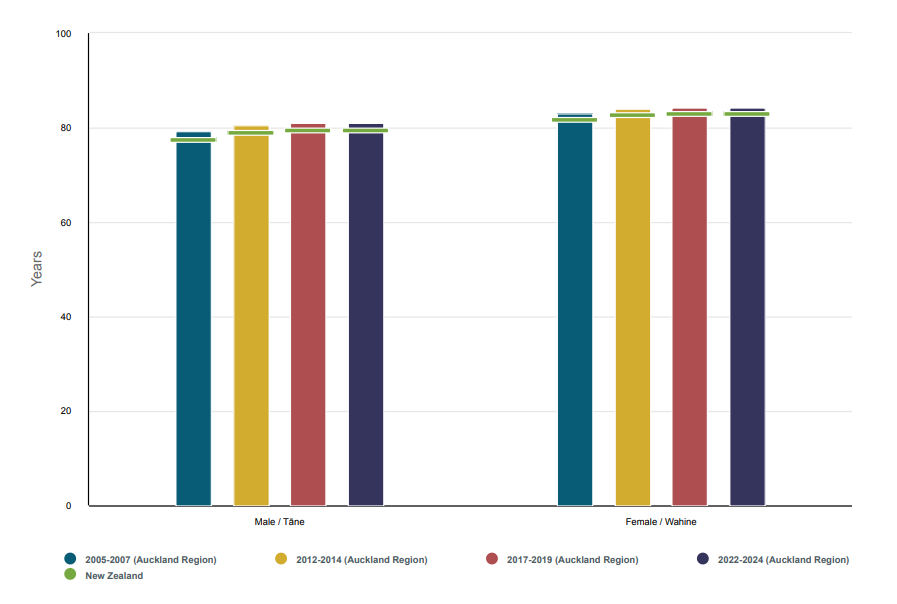
Aucklanders also enjoy a slightly higher life expectancy (82.7 years vs 81.8 nationally).
Life expectancy at birth, by sex, Auckland Region and New Zealand, 2005–2007 to 2022–2024
Source: Stats NZ
👉 As more people move into older age, health needs typically increase — which may lead to greater demand for public healthcare and related services. A longer life expectancy also means it’s important to plan ahead financially for retirement and future healthcare needs.
Auckland’s economy and cost of living
Auckland is New Zealand’s economic powerhouse, accounting for 38.2% of GDP and 35% of all jobs in the country, and is home to over a third of NZ businesses (229,770 out of 654,465).
Households also earn more, with average income at $166,127 compared to $135,224 nationally.
However, this comes with higher living costs.
- Average rent: $635 vs $577 nationally
- Mortgage payments: ~44.3% of household income
👉 When a large portion of income goes towards fixed costs, even a short disruption — such as illness, injury, or the loss of a loved one — can put serious pressure on finances.
Healthcare pressures
Cancer cases continue to increase in Auckland. Since 2017, over 2,000 Aucklanders are diagnosed with cancer each year, and more than 600 pass away from the disease.
Access to public healthcare is still a challenge for many Aucklanders.
- From April to December 2025, 86-89% of cancer patients were treated within 31 days of a decision to treat.
- Only about 6 in 10 people got their first specialist assessment or elective treatment within 4 months.
Auckland health target results
| |
April - June 2025
|
July - September 2025
|
October - December 2025
|
|
Faster cancer treatment
Proportion of eligible cancer patients who received their first treatment within 31 days of decision to treat
|
85.9%
|
89.2%
|
88.4%
|
|
Shorter wait times for first specialist assessment
Proportion of people waiting less than four months for their first specialist assessment from the
date of referral
|
63.7%
|
60.0%
|
61.1%
|
|
Shorter wait times for elective treatment
Proportion of people given a commitment to treatment waiting less than four months, as a
proportion of all people waiting for a procedure
|
56.4%
|
62.9%
|
61.6%
|
Source: Health New Zealand
Delays in diagnosis and treatment can allow conditions to worsen, potentially leading to more complex health issues and longer time away from work. This can reduce income at a time when financial pressure is already increasing.
If private care is needed, costs for surgery, cancer treatment, or unfunded medicines can quickly add up — often reaching tens of thousands of dollars without insurance.
When illness or injury happens, the last thing you want to worry about is money.
Personal insurance gives you the freedom to focus on your health without worrying about finances by:
- Covering private medical costs and getting you faster access to treatment
- Replacing your income, so you can take time off work without pressure
- Providing lump sum benefits, so you and your family stay financially secure despite health setbacks.
Auckland vs New Zealand: Key statistics at a glance
|
Indicator
|
Auckland
|
New Zealand
|
|
Population (2025)
|
~1.8 million
|
~5.3 million
|
|
Median age (2023)
|
35.9
|
38.1
|
|
% of population 65 years and over (2023)
|
13.3
|
16.6
|
|
Life expectancy (2023)
|
82.7 years
|
81.8 years
|
|
Faster cancer treatment (Oct - Dec 2025)
|
88.4%
|
87.0%
|
|
Shorter wait times for first specialist assessment
|
61.1%
|
62.2%
|
|
Shorter wait times for elective treatment
|
61.6%
|
64.5%
|
|
Cancer registrations (2023)
|
2,380
|
29,719
|
|
Cancer deaths (2022)
|
647
|
10,538
|
|
Mean household income (2025)
|
$166,127
|
$135,224
|
|
Average weekly rent (2025)
|
$635
|
$577
|
|
Mortgage as % of income (2025)
|
44.3%
|
38.9%
|
|
GDP share(2025)
|
38.2
|
—
|
|
Businesses (2025)
|
229,770
|
654,465
|
Sources: Stats NZ, Health New Zealand, Infometrics
Protection for Auckland business owners
Most (89%) of Auckland’s 229,000+ businesses have 5 employees or less. That structure matters because business operations, revenue, and client relationships are often tied to just one or two people.
👉 If a business owner or key person is unable to work, the impact can be immediate — affecting income, continuity, and long-term growth.
Business and group insurance can help reduce this risk, providing financial support when it’s needed most.
At Policywise, we help structure insurance plans that protect small, medium, and large companies if something happens to their business owners or key employees.
- Business insurance – provides either a lump sum or monthly payments to keep your business running and your expenses paid in case you suffer a long-term or total permanent disability, are diagnosed with a terminal illness, or pass away
- Key person insurance – helps cover recruitment, training, and other company expenses if a vital team member (such as a founder, shareholder, top executive, or specialist) can’t work due to death or disability
- Self-employed insurance - tailored cover for self-employed individuals
- Farmers insurance - supports rural/agricultural businesses’ cashflow with monthly payments when a farmer or key person can’t work due to illness or injury.
Insurance solutions for Auckland employees
Instead of relying solely on salary increases, businesses can use group insurance as a cost-effective, high-impact benefit. It can help your company:
- stand out from other employers
- attract and retain top talent
- reduce staff turnover and hiring costs
- support employee wellbeing and performance.
Get the best-value group insurance for your team, with instant cover for pre-existing conditions (for eligible team sizes), optional family cover, and competitive pricing.
We take care of everything, from comparing group plans with leading insurers to delivering a simple one-page summary, setting up your cover, supplying a presentation deck for stakeholders, providing staff communication, negotiating with insurers, and offering claims support. With Policywise, you get a done-for-you group insurance solution that saves you time and money.
- Employee health insurance – covers private hospital surgical and non-surgical treatments, and cancer care
- Group life insurance – provides a lump sum payment if an employee passes away or is diagnosed with a terminal illness
- Group income protection cover – replaces a portion of an employee’s monthly income while they can’t work due to injury or illness
- Group critical illness cover – provides a lump sum if an employee suffers a critical illness, such as cancer, heart attack, or stroke
- Group total permanent disability insurance – offers a lump sum if an employee suffers a permanent disability.













.png?width=272&height=60&name=PartnersLife_Wordmark_RGB-2%20(1).png)
.png?width=226&height=42&name=logo_southern-cross%20(1).png)